Friday, July 8, 2011

Bubur Ayam Jakarta (Jakartan Chicken Porridge)

I love this. This might really be one of my absolute favorite foods.
If you're truly from Jakarta, you don't call it 'bubur ayam', or chicken porridge. True locals call this 'bubur abang'. 'Bubur' means porridge and the word 'abang' means older brother. It's a little weird, but let me explain.

Street food is big where I'm from. If you're hungry, it doesn't matter what time of day it is; you can walk out on to street and find food vendors everywhere. It's really cheap, too.
Credit to khurram at travelermania
Credit to Rebecca Distler at The Globalist
Credit to khurram at travelermania
My point is, there's a lot of food. One of the most popular street foods in Jakarta, especially for breakfast, is the chicken porridge. Like I said before, it's called 'bubur abang', or older brother's porridge. It's called that because many of the vendors are men, and they're most likely 25 years old, or older. So, we call the porridge 'older brother's porridge' in order to refer to the Jakartan porridge that's sold on the street.

I remember when I was little, I had to wait until my dad went off to work before I could eat this. He didn't want me eating stuff from the vendors because, well, they're not the most sanitary things. My mom has nothing against it, so my dad got mad at her a lot for enabling me. I got really annoyed with my dad sometimes. I couldn't wait to grow up. That way I can eat whatever the hell I want.

So, I made some porridge today. I forgot how dangerous it can get. It was bubbling and it kind of splattered all over the place. I got a burn on my hand. Not fun.
I did anticipate some stirring to be involved though. For those of you who have never made porridge or congee before, it takes about 1 and a half to 2 hours to get it to the right consistency. And, that's if you use cooked rice. If you use uncooked rice, you can expect to stand in front of the stove for about 2 and a half to 3 hours (depending on how much you're making), continuously stirring the damn thing until it's smooth.

20 minutes in...
After about 2 hours of continuous stirring...
If you want to make this, make sure you have at least 3 hours of free time. Just saying.
The porridge is made from rice, obviously, chicken broth, water, and most importantly, Indonesian bay leaves. Just two or three for 1 and a half cups of rice. It can't get any simpler. It just needs time and care.
The traditional 'meat' in this dish is chicken--Indonesian fried chicken.

Well-seasoned, crispy fried chicken. Good, huh? Don't get too attached to it. I'm going to have to shred it and ruin it for you.

Oh, I have something very important to say. Do not throw away the skin. I will find out and hunt you down. Whenever I see people use cooked chicken, whether it's fried or roasted, they throw away the skin. *cough cough* Food network people *cough cough* It pisses me off.
Anyway, back to the topic at hand.
There are ready to use seasoning mixes for this fried chicken. Since I'm not my mother, I used the mix--with some added ingredients, of course. I added a couple slices of galangal root and some Indonesia bay leaves.
This is the seasoning mix I use.
We shall assemble.
A couple ladlefuls of porridge and some chicken...
Add Chinese crullers and green onions...
Add tapioca crackers, Indonesian sweet soy sauce, and some chili  sauce
Now, take a spoon and give 'em hell.

Thursday, July 7, 2011

The good potato bread and the bad potato bread

Yes, there is such a thing as bad potato bread.

I found the recipe for the bad potato bread above here. It's just... uh. It turned out all crumbly, dry, and just... uh. I still have a whole loaf left. I don't know what the hell to do with it.

Now, let us move on to the good (awesome) potato bread. I found the recipe for this potato bread in an old issue of Sedap Sekejap: Khusus Pemula from 2004. My mother and I loved this magazine. Most of the recipes are well-tested and kind of foolproof. Now, the bad thing for you American cooks who don't own scales is that measurements are all in metric. God, just invest in one. I promise you that it'll be worth it.


GOOD Potato Bread

400 g of high protein flour
100 g of potatoes, boiled and mashed
50 g of sugar
about 7 g (or 1/4 oz) of dry yeast
2 egg yolks
150 ml of lukewarm water
100 g of butter
1/4 tsp of salt
about 100 ml of milk (for brushing at the end)
  1. Grab either a stand mixer or hand mixer, and attach the dough hook. Don't make this any harder than it has to be.
  2. Put the flour (all of it), yeast, sugar and egg yolks in a bowl, and mix.
  3. While the machine is on, slowly pour in the water.
  4. Add butter and salt. Mix until the dough is elastic and separates for the mixing bowl. It should all stick to the dough hook by now.
  5. Let the dough rest for 30 minutes. If it's warm enough in your kitchen, you can let the dough rest on the counter with a kitchen cloth covering it. If not, you can do what I did and let it proof in the oven. You can find the instructions here.
  6. Punch the dough, and dump on to a floured surface. Portion the dough into balls weighing about 50 grams each. You can make it bigger if you want, though.
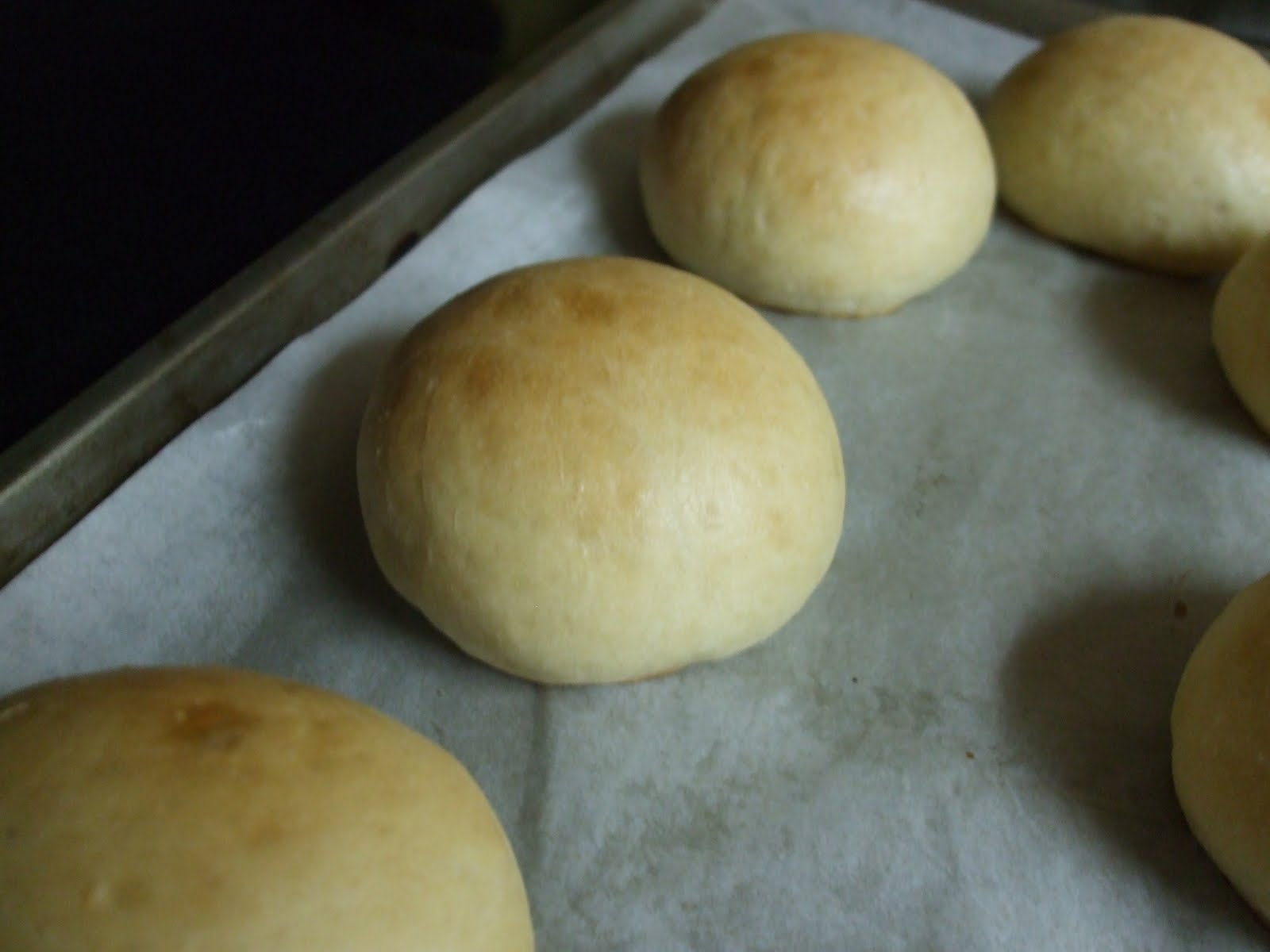
  7. Let it rest on a lined baking sheet for 30 minutes. Brush the dough with milk, and bake for 12 to 15 minutes at 340 degrees Fahrenheit.

Fabulous.
I don't use that word a lot, but these are totally fabulous. Man, I sound like teenager. Wait, I am a teenager.
Anyway, you should definitely try these. They have this wonderful crusty, but not tough, outsides. But, in the inside, they are so soft and fluffy. It's good bread--tremendously good bread. I've had two already.


Monday, July 4, 2011

In search of future projects and lumpia (Indonesian spring rolls)

It was not a very happening day yesterday. I got home from work and had a serious hankering for grilled cheese. So, I made myself some. With lots of butter. Yum.

When evening came, I made myself some dinner (left over fried chicken and gratin) and began to rummage through my mother's stash of cookbooks. It was interesting. I found Chinese cookbooks. That are in Chinese. Huh. I set those aside. 
Then, I found a book solely about cupcakes. I thanked God. I'm not much of a cupcake baker. I mean, I try. And, recently, I failed miserably; I tried to make Bakerella's sweet potato and bourbon cupcakes. Did not work out at all. But, in my defense, I didn't start out baking cupcakes and cookies with my mom like other normal kids. I made food.

Later that night, I flipped through Burnt Lumpia's posts. Have you heard of him? 'Cause you absolutely should. His posts are wonderful. I love how he incorporates his Filipino upbringing in his food and in his blog.
Anyway, I got home this afternoon from a failed attempt to see Transformers 3 (it was sold out. I'm failing a lot these days). And, I made some lumpia.

Lumpia is the Indonesian word--and apparently, also the Filipino word--for spring rolls. Not the Vietnamese kind (you know, the one wrapped in rice paper and isn't cooked?), but the Chinese kind. A bajillion (yes, that is an exact number) years ago, Chinese immigrants settled in Indonesia and the Philippines, bringing this wonderful food. The Hokkien (a group of Chinese dialects) word for spring roll is lunpia. Under Dutch rule (cause it might as well have been), the word evolved to lumpia.

If you look carefully in the first picture, I did kind of burn one of them, the one with the busted end, in honor of Burnt Lumpia. Don't worry. It's still great; I ate it just now. Unfortunately, I can't disclose the recipe for these lumpia. Sorry. It's kind of a family thing. My mother would flip her shit.

I can, however, tell you a couple of general ingredients. As you probably know, the wrapper is store-bought. Do not, I repeat, do not get the white spring roll skin. Those are for Vietnamese spring rolls. Get the ones that say "spring roll pastry". The filling contains shrimp, bamboo shoots, and Indonesian sweet soy sauce (we use this A LOT). It's called kecap manis. Kecap sounds a lot like ketchup. So, when my family first got here, there was a lot of confusion. Anyway, this type of filling originated from Semarang, the capital city of Central Java. It's traditionally eaten with a thick brown gravy, but I was lazy.

So, I had some sweet and spicy chili sauce with it. Still awesome. Yum.
I now have a pretty uneventful evening ahead of me. I have stuff I need to prep for work. I guess I'll reluctantly do that. meh.

Friday, July 1, 2011

Snack time!

Chips--or any fried food, really--are my guilty pleasure. 'Nuff said.


I woke up feeling really tired today. I wanted to stay in bed so badly, but sucks for me, I had to work. I got up at around 6:40, took a shower, and  hurried along. Our orders (you know, like, rice, fish, etc.--all of our supplies) came in today, and me and my brother had to do some heavy lifting. phew.
I thought I deserved a treat. I got home and fried up them taters.

So, as I said before, I had a bunch of potato and sweet potato slices left from the gratin. I'm munching on some right now as I am typing this post. They're delicious, by the way. 
They're just... chips. I honestly don't know what the hell else to say about them. Well, except that you absolutely should try to make your own. Have you ever made homemade potato chips? You haven't? Shame on you! It only takes about 10 to 15 minutes to fry up one batch.


I seasoned the sweet potato chips with salt, and the regular potato chips with salt and pepper. I hate it when chips are overly salty, or overly seasoned with all sorts of powder. It's just not how things are supposed to be!


Good stuff.